Questions, answered.
Choose a product on the left, then a topic. Every answer is written from how the product actually works, including what it does not do.
POS FAQ
35 questions about POS, Multi-Store Cloud POS.
#basics Basics & fit
What is POS?
POS is QGenx’s retail billing system. It handles barcode checkout, promotions, returns and loyalty at the counter, goods receiving in the store, and sales reporting for head office.
Who is POS built for?
Retail stores and multi-store chains that bill by barcode and want counters, receiving and reporting connected. It suits apparel, footwear, lifestyle, supermarkets and similar formats.
Do I need to run many stores to use it?
No. A single store can start with the counter workflow. The company-and-store structure is there when you grow.
Can POS handle several stores and brands?
Yes. Companies, stores, employees and users are managed in one shared application with head-office views across stores. We do not claim every brand is a separate legal tenant.
Is POS a full accounting system?
No. It records sales, tax on receipts, returns and stock movement. It is not a general ledger or tax-filing tool.
Does POS work without internet?
Offline billing is not part of the current offer. Ask us in a demo about your connectivity and we will say plainly whether it fits.
How is POS different from a generic billing app?
It connects the counter to merchandise receiving, supplier returns, stock availability and head-office reports in the same system, instead of billing alone.
#features Features
How does barcode checkout work?
The cashier scans an item, and its price and tax come from the store catalogue. The bill builds up as items are scanned.
Can I sell by weight or length?
Yes. Measured quantities are supported for loose items.
How are promotions applied?
Promotions are configured by head office. The bill calculates eligible offers automatically, and offers can be assigned to chosen stores.
Can I use coupons?
Yes. A coupon can be applied to a bill and removed again before payment.
What payment information is recorded?
POS records how each bill was paid. It does not process card or UPI payments itself.
How do customer returns work?
A return is linked to the original invoice. The resulting credit can be used on a later purchase.
How does the loyalty programme work?
Customers are identified by phone number and points accumulate against that number. You can view a customer’s purchases and points.
#setup Setup & data
How do I load my products?
Merchandise is loaded per store, and a CSV maintenance route exists for bulk changes. Brand, department, size, colour and measured units are supported attributes.
Can I migrate historical sales?
A historical sales migration route exists. We scope it per project, because source data quality varies.
How are users and permissions handled?
Users get roles, and menus are controlled by role, so a cashier sees the counter and head office sees reports.
Can tax rules be configured?
Yes, tax and promotion rules have administration screens. Receipts show tax calculated from those rules.
What is a financial-year setup?
POS holds a financial-year configuration so documents and stock periods line up with your accounting year.
How do I receive stock into a store?
Head office uploads a delivery file and prepares an advance shipping notice. The store then receives by scanning boxes and products.
How long does implementation take?
Implementation takes between 7 and 20 days, depending on the product you choose. It depends on stores, catalogue size and data cleanliness. We pilot one store first and expand once the workflow holds.
#operations Day to day
How do I know how much stock a store has?
Availability is computed from opening stock and every movement: receiving, sales, returns and supplier returns.
Can I count physical stock?
Yes. Counting sessions record scanned quantities. We do not currently offer automatic posting of a count into opening stock.
How do I send goods back to a supplier?
Supplier goods-return documents record the outward movement as a separate workflow, using the return pricing settings.
What can head office see?
Sales summaries, the Sales Abstract, goods-movement reports and customer purchase and points views across stores.
Does POS send reports by message or email?
A Telegram reporting component exposes predefined business reports, and scheduled email delivery exists. We confirm what is switched on for you during setup.
Is there an activity history?
Yes. System administration includes activity history, so changes can be traced.
Does POS track employee attendance?
A supporting attendance component captures check-ins with location through Telegram. It is a supporting module, not the core of POS.
#demo Demo, plans & support
How do I see POS working?
Book a 30-minute demo. We start with your store workflow and show the counter, receiving and reports on that basis.
Which plan should I choose?
Plans are Basic, Premium and Enterprise. We recommend one after understanding your stores and users. Ask us for details; we do not list prices on the website.
Can I try it with my own products?
We can load a sample of your catalogue for the demo so you see your own items at the counter.
What support do I get?
Support is available by email at support@qgenx.io and WhatsApp. Existing customers are routed to the support process.
Can POS connect to my other QGenx products?
Where two workflows benefit from shared data, such as product masters feeding the catalogue, we connect them deliberately, scoped per project.
Will you customise POS for us?
We configure rules, masters, roles and reports first. Anything beyond that is scoped honestly, with the effort stated up front.
Where is my data stored?
Hosting details are confirmed per project during the demo. See the Privacy Policy for how we handle data in general.
Stockify FAQ
35 questions about Stockify, Warehouse Management.
#basics Basics & fit
What is Stockify?
Stockify is QGenx’s warehouse and order-operations system: purchase receiving, customer bookings, stock holds, sales-order approval and pick preparation.
Who should use Stockify?
Distributors, wholesalers, brands with their own warehouse and fulfilment teams that receive by barcode and commit stock to customers before dispatch.
Is Stockify a full ERP?
No. It does not replace accounting. It focuses on receiving, booking, holds, approval and picking.
What does “stock-aware” booking mean?
Bookings and sales orders are created with the stock position in view, and holds and reservations keep promised quantities separate from free stock.
Does it replace my accounting software?
No. Stockify handles warehouse and order operations only.
Does it support multiple warehouses?
Yes. Warehouse and storage-location setup is part of the product.
How is it different from a stock spreadsheet?
Receiving, approvals, holds and picks are recorded steps with owners, not cells anyone can overwrite.
#features Features
How does purchase approval work?
A purchase uploaded from a file must be approved before it appears in the receiving queue.
How does box-wise receiving work?
The operator opens an approved purchase and scans products box by box. Each box is recorded against the receipt.
What happens when quantities do not match?
Shortage and excess are recorded against the purchase and shown in inward reconciliation reports.
What is the difference between a booking and a sales order?
A booking is the customer’s request. A sales order is a committed document created from it, and it goes through approval.
What is a proforma hold?
A proforma document holds its own stock so it can be offered to a customer without confirming a sale.
What is full-remainder reservation?
A deliberate action that reserves everything left on a booking. You can later convert or release it.
Can customers have their own pricing?
Yes. Customer-based order pricing is supported when bookings are created.
#setup Setup & data
How do I load products?
Through a validated bulk upload that checks the file before importing, plus a searchable catalogue with variants.
How do I load orders in bulk?
Bulk order booking accepts a file and creates bookings, using the same checks as manual entry.
How are warehouses and shelves set up?
You define warehouses and storage locations, and pick instructions reference them.
Can I set different user roles?
Yes. Users, roles and menus are managed, with session and login controls.
What masters do I need?
Billing, channel and supplier records, plus reference masters for business configuration.
How are purchase orders imported?
Purchases are uploaded from a file and listed in a purchase register.
How long does setup take?
Implementation takes between 7 and 20 days, depending on the product you choose. It depends on catalogue size and locations. We start with one flow, usually receiving or booking, and widen after it works.
#operations Day to day
How do I see current availability?
Availability and a shelf ledger show stock by product and by recorded location.
Can I do physical counts?
Counting sessions capture scans. They record observations and do not adjust the shelf ledger automatically.
How are pick instructions produced?
Approved sales orders generate pick slips that reference shelf locations, which can be planned and printed.
Is there a progress view?
Yes. A warehouse tracker shows the recorded stage of each document.
Can I export data?
Operational reports can be exported to XLSX.
Do users get notifications?
In-application notifications are included.
What about packing and invoicing?
Packing and packed-quantity invoicing exist in the code but are not offered as finished capabilities. We will say when that changes.
#demo Demo, plans & support
How do I see Stockify working?
Book a 30-minute demo. We use your receiving and booking flow as the example.
Which plan do I need?
Basic, Premium or Enterprise, depending on warehouses, users and support needs. We discuss this after the demo; no prices are listed on the site.
Can I try it with my own data?
We can load a sample of your products and a purchase for the demo.
How do I get support?
Email support@qgenx.io or message us on WhatsApp.
Can Stockify work with POS?
The two can be connected where it removes work, such as store receiving against warehouse dispatch. This is scoped per project.
Do you customise workflows?
We configure first. Anything beyond configuration is scoped and priced openly before work starts.
Where is the data hosted?
Confirmed per project during the demo.
Stylify FAQ
35 questions about Stylify, Product & Production.
#basics Basics & fit
What is Stylify?
Stylify is QGenx’s product master data product. It holds styles, their barcode-level variants and the attributes that describe them.
What is product master data?
The single, agreed record of each product: its style, variants, barcodes, prices and attributes, which other systems rely on.
Who is Stylify for?
Fashion, footwear and lifestyle teams and anyone with SKU-heavy ranges that live in spreadsheets today.
How is a style different from a variant?
A style is the product as a design, for example a cotton shirt. Variants are its purchasable forms, such as each colour and size with its own barcode and MRP.
Does Stylify bill customers?
No. It is the product layer. Billing and checkout belong to POS and Billify.
Does it replace my ERP?
No. It serves as the product master that other products and sheets draw from.
Do I need other QGenx products?
No. It stands alone, and connects to others only when that removes repeated work.
#features Features
Can I define my own attributes?
Yes. Attributes are configurable columns with their own values, and you can have many of them.
How are variants created?
Choose a master colour and size group and the variants are generated, with barcodes following your rule.
How are barcodes handled?
Barcode and SKU identifiers follow settings you control, so they are generated rather than typed.
What happens to a new attribute value found in an upload?
It is created automatically, so valid rows are not rejected for a missing list entry.
Can I keep half-finished products out of use?
Yes. Products can stay in draft and be published when complete.
Can I attach images?
You can attach image URLs to styles and variants.
Does it handle tax codes?
Tax code and unit of measure are held on the product and can be inferred during upload.
#setup Setup & data
Which file types can I upload?
CSV and XLSX.
What does the upload do?
It reads the sheet, previews what will be created or updated, flags rows that fail, and shows progress on large files.
Can I update existing products by upload?
Yes. Uploads can create new records and update existing ones.
What masters do I set up first?
Company, stores and financial year, then attribute columns and values, then the products.
How do I migrate from spreadsheets?
We map your columns to the style, variant and attribute structure, then upload a sample category to check it.
Can several people work on it?
Yes. Users and roles control who can edit and who can only view.
How long does setup take?
Implementation takes between 7 and 20 days, depending on the product you choose. It depends on your attributes and the state of your data. A single category is the usual first step.
#operations Day to day
How do I find a product?
Search the catalogue by style or variant and filter by attributes.
How do I deactivate a variant?
Variants carry a status, and visibility can be controlled so inactive variants stay out of use.
Can I export the master?
Yes. Product and variant data can be exported to XLSX.
Does it show who changed a record?
Authentication, sessions and administration features are included; we confirm audit detail during the demo.
What if a bulk upload has bad rows?
Valid rows continue and the bad ones are flagged so they can be fixed and re-uploaded.
Can stores see the master?
Access is by role, so stores can be given read access only.
Can the master feed marketplace catalogues?
Yes. Listify reads product data for marketplace files; this connection is scoped per project.
#demo Demo, plans & support
How do I see Stylify working?
Book a 30-minute demo and send us a sample of your product sheet if you can.
Which plan do I need?
Basic, Premium or Enterprise, depending on the size of the range and the number of users. We do not list prices on the site.
Can you load my sheet for the demo?
Yes, if you share a sample beforehand we can preview it in the upload screen.
How do I get support?
Email support@qgenx.io or message us on WhatsApp.
Can Stylify connect to POS or Stockify?
Yes, where a shared product master removes repeated entry. It is scoped per project.
Do you customise attribute structures?
Attributes are configurable by you. Other changes are scoped openly.
Where is the data hosted?
Confirmed per project in the demo.
Billify FAQ
35 questions about Billify, Billing & Invoicing.
#basics Basics & fit
What is Billify?
Billify is QGenx’s invoicing product for client-based billing: saved clients and services, draft and confirmed invoices, branded print, and billing and GST reports.
Who is Billify for?
Service businesses, agencies, consultants and any team that issues itemised GST invoices to a set of clients.
Is Billify an accounting package?
No. It prepares invoices, registers and reports. It is not a general ledger.
Can I bill for goods as well as services?
The catalogue holds products and services, with fields suited to service billing such as service group and billing model.
Does Billify do inventory?
No. There are no stock quantities in Billify.
Does it support multiple companies?
Billify works in a company context with its own profile, tax settings and financial year.
Do I need other QGenx products?
No. Billify stands alone.
#features Features
What is the difference between a draft and a confirmed invoice?
A draft can be edited or discarded. Confirming allocates the invoice number and fixes the document.
How does GST work in Billify?
The invoice carries a GST breakdown, rounding is applied, and tax settings are configured in a tax master. Reports cover GST and HSN.
Can I copy an old invoice?
Yes. Copying creates a new draft with the same lines and terms and resets the document-level details.
Can I add my own terms?
Yes. Reusable terms can be saved and attached to invoices.
How do I print or send an invoice?
Print it or save a PDF from the browser using the branded layout.
Can I record payments?
Yes. Manual payment receipts attach to an invoice, with a receipt register and payment reports.
Does Billify handle recurring invoices?
A schedule screen exists for source-invoice schedules, but automatic recurring generation is not promised yet.
#setup Setup & data
What do I set up first?
Company profile, tax settings, financial year, clients, the service catalogue and your terms.
Can I import clients?
We load client and catalogue data for you during setup; confirm the format with us in the demo.
How is the invoice number decided?
You configure numbering, and a number is allocated when you confirm the invoice.
Can I put my logo on invoices?
Yes. The company profile sets the document identity, and invoices print in a branded layout.
Can several people use it?
Yes. Authentication, sessions and access controls are part of the product.
Which financial year is used?
Billify holds a financial-year context for documents and reports.
How long does setup take?
Implementation takes between 7 and 20 days, depending on the product you choose. Usually short, because it is masters plus a template. Timing depends on how much client data you bring.
#operations Day to day
How do I find an invoice?
Use the invoice register with search and filters.
Can I cancel an invoice?
Yes. A cancellation action exists for confirmed invoices.
What reports are available?
Billing, GST, HSN and payment reports, plus a dashboard overview.
Does it track who has not paid?
Not automatically. Manual receipts and payment reports exist, but overdue tracking and a reconciled receivables ledger are not offered yet.
Can I export reports?
Reports can be filtered; we confirm export formats during the demo.
Can I change tax rates?
Tax settings are configurable in the tax master.
Is there a dashboard?
Yes, a billing overview.
#demo Demo, plans & support
How do I see Billify?
Book a 30-minute demo. We use your own invoice layout as the example.
Which plan do I need?
Basic, Premium or Enterprise depending on users and support. We do not list prices on the site.
Can you match my invoice layout?
The company profile controls document identity; we check how close we can match in the demo.
How do I get support?
Email support@qgenx.io or message us on WhatsApp.
Does Billify connect to my accounting software?
Not out of the box. Integrations are scoped per project.
Will you customise it?
We configure first; anything beyond that is scoped openly.
Where is my data stored?
Confirmed per project during the demo.
Listify FAQ
35 questions about Listify, Catalogue & Listing.
#basics Basics & fit
What is Listify?
Listify is QGenx’s marketplace catalogue product. It reads marketplace templates, maps your product fields to their columns and generates catalogue files.
Does Listify publish to marketplaces?
No. It generates files you upload on the marketplace portal. There is no marketplace API publishing.
Which marketplaces does it support?
Flipkart, Amazon and Myntra templates are parsed, and other spreadsheet templates can be mapped using the same mapper. Ask us about a specific one.
Who is Listify for?
Ecommerce brands, D2C labels, catalogue teams and agencies preparing marketplace uploads.
Do I need to store products in Listify?
Yes, or load them from a sheet. Listify generates files from the product data it holds.
Is it only for fashion?
The attribute set is rich for apparel, but any product with a spreadsheet template can use the mapper.
Is Listify different from Stylify?
Stylify is the product master. Listify turns product data into marketplace files. They can share data.
#features Features
How does template parsing work?
You upload the marketplace’s Excel template and Listify reads its columns, mandatory fields and allowed values.
What is field mapping?
Connecting each marketplace column to one of your fields, with coverage showing what is still unmapped.
Can it translate my values to the marketplace’s?
Yes. Value lists can be mapped, for example your colour names to theirs.
How are variants created?
Choose a master colour and size group and the variants are generated.
Are AI descriptions required?
No. They are optional and only work where an AI endpoint is configured. Review them before use.
Can I attach images?
You can attach image URLs to products and include them in the file.
Does it check data before generating?
It has draft status and validation of fields so incomplete products stay out of the file.
#setup Setup & data
How do I load my products?
From a CSV or sheet, or by authoring styles and variants in the tool.
How do I add a new marketplace?
Set up the marketplace and category, upload its template, and map the fields.
Do I have to remap every time?
No. Mappings are saved and reused.
How many attributes can I define?
As many as you need. The system was built around a very large attribute set for fashion.
Can several people work on it?
Yes. Users, roles and navigation administration are included.
How are barcodes and SKUs set?
Through identifier settings, so variants get generated codes.
How long does implementation take?
Implementation takes between 7 and 20 days, depending on the product you choose. We start with one marketplace and one category, then widen once the file is accepted.
#operations Day to day
How do I generate a file?
Pick products and a marketplace, and run an export job. It shows progress and keeps the file.
Can I re-download an old file?
Yes. Export jobs and history are kept.
What if a marketplace rejects the file?
Fix the field or the mapping and regenerate. The mapping is saved for next time.
Can I update many products at once?
Yes, using bulk style and SKU maintenance.
Does it manage stock or orders?
No. Listify handles catalogue data only.
Can I keep products private until ready?
Yes, through draft status.
Does it keep an audit trail?
The report describes audit logging for catalogue changes. We confirm the depth in the demo.
#demo Demo, plans & support
How do I see Listify working?
Book a 30-minute demo. Send us the marketplace template you use and we will map it live.
Which plan do I need?
Basic, Premium or Enterprise, depending on marketplaces and users. No prices are listed on the site.
Can you map my template in the demo?
Yes, if you send it ahead.
How do I get support?
Email support@qgenx.io or message us on WhatsApp.
Does Listify connect to POS?
It can read product data from the same master. Scoped per project.
Will you customise for a new marketplace?
Template mapping is configuration. Anything else is scoped openly.
Where is data stored?
Confirmed per project in the demo.
Assetify FAQ
35 questions about Assetify, Asset Management.
#basics Basics & fit
What is Assetify?
Assetify is QGenx’s physical-asset register. Each asset gets a QR-based and barcode-based identifier, with photographs and a named owner.
Who is Assetify for?
Hospitals and other site-based organisations that need an asset register with ownership. It also suits any team with physical assets.
Where should we start with Assetify?
Start with one location as a pilot, then add the rest.
Does Assetify handle maintenance or depreciation?
No. It is a register and ownership record, not a maintenance, procurement or accounting system.
Can a doctor be an owner?
Yes. Company, Department and Doctor are supported owner types, and doctors need not be application users.
Does it track assets in real time?
No. It records captures and ownership changes; it does not track location live.
Does it work on phones?
It is browser-based, so capture works from a device with a browser. We confirm hardware in the demo.
#features Features
How does capture work?
Scan the QR code or barcode, complete the template, add photographs and assign an owner. All are saved together.
How many photos can I attach?
One to six per asset.
How are asset codes made?
They are generated automatically with a company and location prefix.
Is ownership history kept?
Yes. An initial ownership record is created and later changes are retained.
Can I design my own capture form?
Yes, through configurable templates and controlled master lists.
Can I edit an asset later?
Yes. Records and details can be updated after capture.
Are there reports?
Operational reports with CSV downloads, and a capture dashboard.
#setup Setup & data
What do I set up first?
Company and locations, then templates and master lists, then users and roles.
How do I limit a user to one site?
Assign each user a location. We note that some read paths do not yet deny access consistently when a non-admin user has no location, so we set locations for all users.
Can I import existing assets?
Existing lists can be brought in through a scoped migration. Confirm format in the demo.
What roles are available?
Roles with per-user permission overrides, and database-driven navigation.
Do I need printed labels?
Each asset needs a QR code or barcode at capture. We can discuss labelling in the demo.
How are departments and doctors stored?
In entity directories you maintain.
How long does a pilot take?
Implementation takes between 7 and 20 days, depending on the product you choose. Setup of templates and a location is usually short; the capture effort depends on the number of assets.
#operations Day to day
How do I find an asset?
Search the register and open the asset’s detail view.
How do I change an owner?
Reassign the asset. The previous owner stays in the history.
Does it send notifications?
In-app operational notifications are included.
Can I see capture progress?
The dashboard shows capture and ownership coverage by role.
Can I export data?
Yes, CSV reports can be downloaded.
Who can see what?
Access follows roles and individual permission overrides.
How are sessions secured?
Login and session controls are part of the product.
#demo Demo, plans & support
How do I see Assetify?
Book a 30-minute demo. We can set up a template for your asset type beforehand.
Which plan do I need?
Basic, Premium or Enterprise, based on locations and users. We do not list prices on the site.
Can I pilot at one location?
Yes, and we recommend it.
How do I get support?
Email support@qgenx.io or message us on WhatsApp.
Can Assetify connect to other products?
Possible where it removes work. Scoped per project.
Will you customise templates?
Templates are configuration you control. We help set them up.
Where is the data hosted?
Confirmed per project in the demo.
StoreX FAQ
35 questions about StoreX, Retail Management.
#basics Basics & fit
What is StoreX?
StoreX is QGenx’s retail operations system. It has Online Operations for channel orders and packing, and Store Operations for store supply and reconciliation.
Why two tracks?
They solve different problems and use different stock structures. We keep them separate so each stays clear.
Is StoreX an online store?
No. It is a back office for orders you already receive, not a storefront.
Does it connect to marketplaces directly?
Orders come in by CSV. Direct marketplace API connection is not part of the current offer.
Is it an accounting system?
No. It reconciles retail quantities and creates credit and debit notes, but it is not a ledger.
Who is StoreX for?
Brands with online channels, warehouses and stores that need packing, supply and reconciliation to line up.
Do the online and store tracks share stock?
Their stock structures are separate. Automatic synchronisation between them is not offered.
#features Features
How does packing verification work?
Packers verify by tracking number or product barcode, and can reprint a label.
What are batches?
Groups of imported orders that move through allocation and packing together.
How are shipment documents handled?
Uploaded PDFs are mapped to the shipment, and manifests can be printed.
How are returns processed?
Returns are registered and the product is verified by barcode.
What is scan-built supply?
A store-supply route where scanning goods into boxes updates the order, pickslip and packing records together.
What does retail reconciliation do?
It matches provisional retail sales with final month-end files and produces store-level credit and debit notes.
Does it handle attendance?
Yes. Employee records, manual attendance and a Telegram check-in feed attendance reports.
#setup Setup & data
How do I load orders?
From a CSV. Historical order loading also exists.
What mappings are needed?
Channel products must map to warehouse products so orders resolve.
How are warehouses and stores set up?
Through business, store and supplier setup and a warehouse layout.
Can I load products in bulk?
Yes, with CSV and image-link maintenance for styles and variants.
Who can use what?
Users and roles control menus, with session checks.
What is needed for reconciliation?
Current and month-end retail sales files, plus invoices.
How long does implementation take?
Implementation takes between 7 and 20 days, depending on the product you choose. We pilot one track and one channel first, then widen.
#operations Day to day
Can I see what has been scanned?
Independent scan registers and scan activity monitoring are included.
How do I count stock?
Physical counting records observations without automatic reconciliation.
Can I export invoices and packing lists?
Yes, as workbooks.
What reporting exists?
Online sales pivots and period comparisons, stock-to-sales and movement analysis, store stock and sell-through reports.
How are stock discrepancies handled?
Invoice-linked stock discrepancy adjustments are supported on the store track.
Can I track warehouse-to-store milestones?
Yes. Milestones are tracked manually through the supply process.
What about courier tracking?
Live courier tracking is a placeholder and is not offered.
#demo Demo, plans & support
How do I see StoreX working?
Book a 30-minute demo. Tell us whether online packing or store supply matters first.
Which plan do I need?
Basic, Premium or Enterprise depending on channels, stores and users. We do not list prices on the site.
Can I try with my own order file?
Yes, send a sample CSV beforehand.
How do I get support?
Email support@qgenx.io or message us on WhatsApp.
Does StoreX work with Stockify or POS?
They can be connected where it removes work. Scoped per project.
Do you customise?
We configure first and scope anything beyond that openly.
Where is data hosted?
Confirmed per project in the demo.
Prism FAQ
35 questions about Prism, BI & Data Analytics.
#basics Basics & fit
What is Prism?
Prism is QGenx’s retail and ecommerce reporting product: pivots, comparisons and merchandise views built on data you record or import.
Who is Prism for?
Analysts, merchandisers, channel managers and owners who review trading performance, especially in apparel.
Is Prism real-time?
It analyses data that has been imported or recorded. It is not a live checkout system.
Does Prism replace Power BI or Excel?
It is purpose-built for retail and ecommerce questions, so common views are ready. It does not claim to replace general tools for every use.
Does it need POS?
No. It works from imported data, and can use data from any source in the right format.
Does it make forecasts?
No. It reports on what has happened, with comparisons and gaps.
Is it only for fashion?
Style, colour, size, fabric and season make it strongest for apparel, but the pivots work for other retail.
#features Features
What can I pivot on?
Store, brand, category, period and other attributes, with comparisons between periods.
What does inventory health show?
Stock-to-sale and cover for products and groups.
How does the margin and markdown view work?
It shows margin movement and the impact of markdowns together.
What is size availability review?
It points out where size runs are broken and where refilling is needed.
Can I rank merchandise?
Yes. Merchandise ranking and internal comparisons are included.
What ecommerce views exist?
Channel sales, return risk and ageing, and assortment and stock review.
Can I download results?
Yes. Reports and datasets download as files.
#setup Setup & data
How do I load data?
By CSV imports for trading data: sales, returns and stock.
What data do I need?
Products, stores, sales and stock at least. Returns improve return and ageing views.
Can I define product attributes?
Yes. Attributes and identifier settings are configurable.
Can I set up marketplaces?
Yes, marketplace and category setup is included for ecommerce views.
How are users and roles handled?
Through users, roles and navigation administration.
How long does implementation take?
Implementation takes between 7 and 20 days, depending on the product you choose. We load one month and prove the numbers against your own reports first.
Does the data need cleaning first?
It helps. We review a sample and advise before import.
#operations Day to day
How often should I import?
As often as you review, such as daily or weekly. It depends on your file process.
Do retail and ecommerce data match automatically?
No. Retail and ecommerce reporting use separate data and are not reconciled automatically.
Can I compare stores?
Yes, using pivots and productivity and space-efficiency views.
Can I see return ageing?
Yes, in the ecommerce return risk and ageing view.
Are all inherited screens live?
We list only verified views. Some inherited screens use simulated figures and are not offered.
Can I share reports with my team?
Reports and datasets can be downloaded and shared; access is by role.
Can I export raw data?
Yes, datasets download as files.
#demo Demo, plans & support
How do I see Prism?
Book a 30-minute demo and send a sample of your sales file if you can.
Which plan do I need?
Basic, Premium or Enterprise depending on data volume and users. We do not list prices on the site.
Can you use my data in the demo?
Yes, with a sample you are comfortable sharing.
How do I get support?
Email support@qgenx.io or message us on WhatsApp.
Can Prism read from POS or StoreX?
Where a shared data path removes work, we scope it per project.
Will you build custom reports?
We configure existing views first. New reports are scoped openly.
Where is the data hosted?
Confirmed per project in the demo.
Company & demo
8 general questions.
What does QGenx build?
Eight focused business products covering retail billing, warehouses, product master data, invoicing, marketplace catalogues, physical assets, retail operations and business intelligence.
Do I have to buy all eight products?
No. Each product stands alone. Start with the workflow causing the most friction and add another only when it removes real work.
Which product should I start with?
Bring one workflow to a demo. We will point to the product closest to the problem rather than sell the whole family.
How long does implementation take?
Implementation takes between 7 and 20 days, depending on the product you choose. We work in seven stages and pilot with a small group before rollout.
Can the products share data?
Where two workflows benefit from shared data, they can be connected deliberately. This is scoped per project rather than assumed.
Is my data safe?
Access control, roles and sessions are part of the products. Hosting and security details are confirmed per project during the demo.
Do you support GST?
GST-aware billing and reporting are available where relevant, mainly in POS and Billify.
How do I book a demo?
Use the Book a Demo page, choose the products you care about and a convenient time. You can also message us on WhatsApp.
No questions match your search.
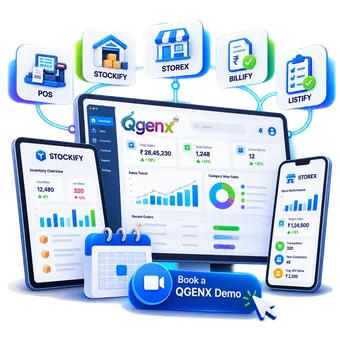
Still have a question? Ask us live.
Tell us about your current workflow, look at the product closest to the problem, and choose a 30-minute slot. A working walkthrough, not a slide deck.
- 30 minutes
- Your workflow, not ours
- No obligation